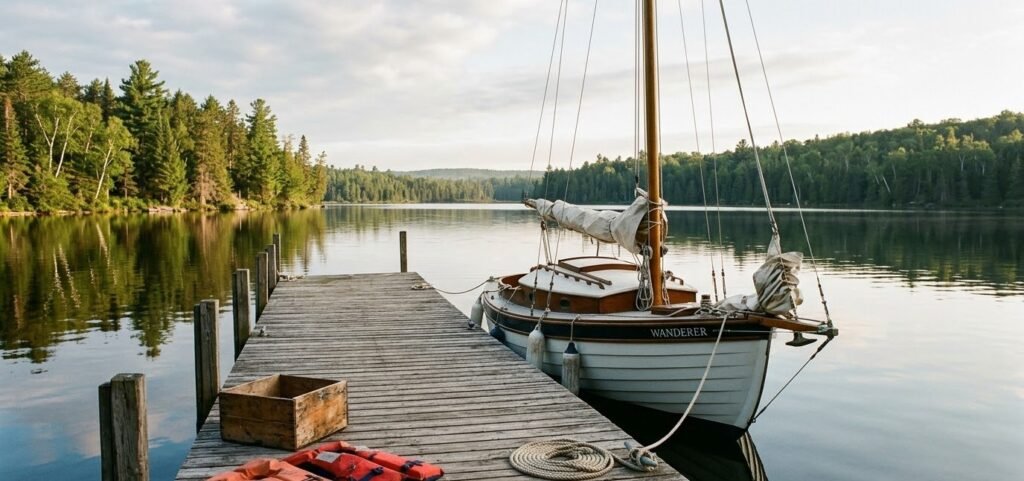
Almost everyone who books a first lesson asks me the same question in the parking lot, and it is never about sailing. It is some version of “how wet am I going to get.” The answer is barely, unless you want to be. What follows is the rest of what happens, in order, so the two hours feel less like an exam.
Before you leave the house
Wear shoes with a closed toe and a sole that grips, and accept that they will be damp by the end. Sunglasses on a string. A hat you do not love, because Mendota takes hats. If the forecast says anything under seventy I will tell you to bring a layer, and people who ignore that advice spend the second hour thinking about the layer instead of the boat.
Leave the gloves at home for the first one. You want to feel the sheet slipping before you learn to grip it properly, and gloves hide that.
The first fifteen minutes are on land
We stand on the dock and I point at things. Bow, stern, port, starboard, mainsail, jib, boom. The boom gets extra attention because it is the part that will hit you if either of us stops paying attention, and knowing where it lives is most of staying out of its way.
Then I show you the boat’s one non negotiable rule: one hand for you, one hand for the boat. It sounds like folklore until the first time somebody stands up to point at a heron and discovers the deck is not a floor.
Leaving the slip
I take her out. You watch. Getting a keelboat out of a tight slip under sail is a party trick and not a teaching moment, and there is no reason to make your first ninety seconds the hardest thing you do all afternoon.
Once we clear the breakwater I hand over the tiller, usually sooner than people expect. Steering is the fastest thing to learn and the most satisfying, and it puts you in charge of something immediately, which changes how the rest of the lesson feels.
What we actually cover
Points of sail, meaning where the boat can and cannot go relative to the wind. There is a moment in every first lesson where somebody tries to sail straight into the breeze, the sails start flapping like laundry, and the boat stops. That moment teaches more than I could in twenty minutes of talking, so I let it happen.
Tacking, which is turning the bow through the wind. Your first three are ugly. Your fourth is fine. Nobody has ever needed more than six.
Trim, a little. Enough to notice that pulling the sail in too far is as bad as letting it out too far, and that the boat tells you which one you have done if you are willing to listen for it.
We do not cover docking, spinnakers, navigation rules, or knots beyond the one that holds the fenders. Those come later and they come easier once you have felt the boat move.
The part people do not expect
There is a stretch, usually around the eighty minute mark, where the talking stops. The boat is going, you are steering, the wind has settled into whatever it is going to do, and neither of us says anything for a while. That silence is the actual product. Everything before it is scaffolding.
I have had two students cry on that stretch, both of them men in their sixties, both of them slightly embarrassed about it. I mention this so nobody feels strange if it lands harder than expected.
Coming back in
You steer until we are near the harbour mouth and then I take her again. We tie up, I hand you a coffee, and we spend ten minutes on what happened. I email notes afterwards because nobody remembers a debrief they heard while still adjusting to solid ground.
If you liked it, the natural next step is a second lesson rather than a course. Two hours teaches you whether you enjoy this. Four tells you whether you want to own a boat, which is a much more expensive question.